If you run a dental college in India, emergency care training has just moved from "good practice" to a documented compliance requirement. In a circular issued on 22 July 2026 (F. No. NDC/UGPG-DEB/Circular/2026/DEB-230), the Under-Graduate & Post-Graduate Dental Education Board of the National Dental Commission directed all recognised dental colleges and institutions to implement structured …

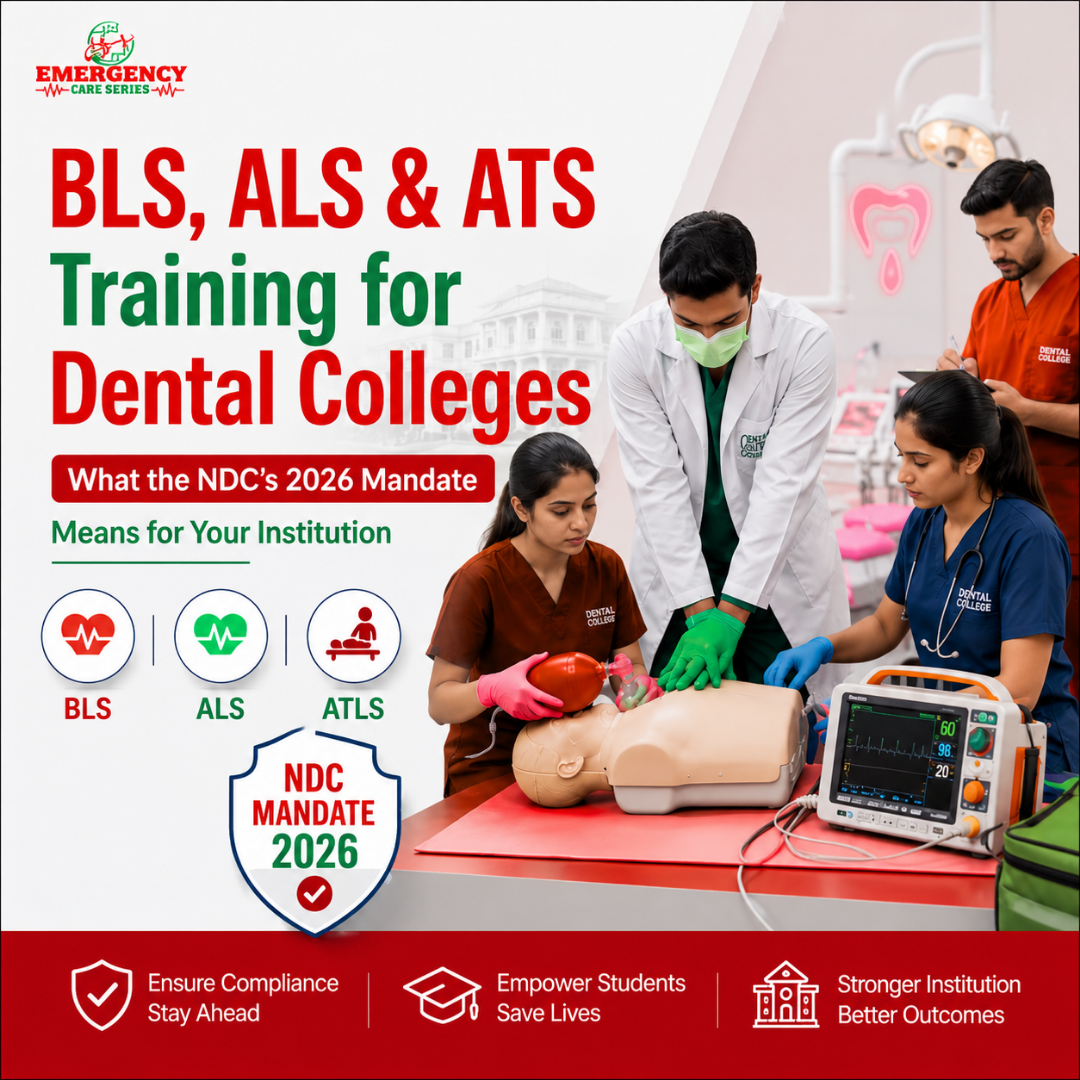
If you run a dental college in India, emergency care training has just moved from “good practice” to a documented compliance requirement. In a circular issued on 22 July 2026 (F. No. NDC/UGPG-DEB/Circular/2026/DEB-230), the Under-Graduate & Post-Graduate Dental Education Board of the National Dental Commission directed all recognised dental colleges and institutions to implement structured Basic Life Support (BLS), Advanced Life Support (ALS) and Advanced Trauma Life Support (ATLS) training and certification frameworks.
The circular is short, but its operational reach is wide. It touches every BDS student before clinical postings, every MDS postgraduate in their first year, every clinical faculty member, para-dental students, and even non-teaching employees. It also asks for something most colleges have never maintained: a central certification registry that will be inspected.
This guide breaks down exactly who needs which certification, what “institutional preparedness” means in practice, and how a dental college can get from circular to compliance inside one academic session.
Key takeaways
- BDS students need valid BLS certification before entering the clinical phase, plus refresher training and simulation exercises for the rest of the course.
- MDS postgraduates need BLS early in year one and ALS certification during the first or second year.
- Oral & Maxillofacial Surgery postgraduates additionally require ATLS certification.
- Clinical faculty must hold active, valid BLS/ALS certification and recertify on schedule.
- Institutions must run unannounced mock drills, maintain emergency drug carts and resuscitation kits, and keep a central certification registry open to inspection.
- Colleges are explicitly advised to collaborate with recognised training organisations, accredited hospitals, medical colleges or emergency medicine departments.
Why the National Dental Commission Issued the BLS, ALS and ATLS Circular
Context matters here. The National Dental Commission replaced the Dental Council of India on 19 March 2026, when the National Dental Commission Act 2023 was notified into force and the Dentists Act 1948 was repealed. The Commission operates through three autonomous boards — the Undergraduate and Postgraduate Dental Education Board for academic standards, the Dental Assessment and Rating Board for accreditation and institutional ratings, and the Ethics and Dental Registration Board for professional conduct and registration.
That structure is why this circular carries weight. It comes from the education board that sets academic standards, and it is signed by Arindam Modak, who heads the NDC Secretariat as Secretary. Compliance is not a departmental courtesy — it feeds directly into the assessment and rating machinery.
The reasoning set out in the circular is clinical rather than bureaucratic. Dental practitioners routinely treat patients with complex systemic illness. They perform invasive procedures, administer local anaesthesia, manage sedation-related care and work in community outreach settings. Vasovagal syncope, anaphylaxis, hypoglycaemia, angina, seizures, airway obstruction from an aspirated instrument or fragment, local anaesthetic toxicity, cardiac arrest — these do not announce themselves, and in a dental college the person standing closest to the chair is often an undergraduate student.
The gap the Commission is closing is the one between “someone will call an ambulance” and “someone will start compressions in the next ten seconds.” That gap is measured in minutes of anoxia, and it is the difference between a recovered patient and a coroner’s file.
Who Must Be Certified: BLS, ALS and ATLS Requirements at a Glance
| Group | Requirement | Timing specified in the circular |
|---|---|---|
| BDS undergraduate students | Valid BLS certification | Before entering the clinical phase; refreshers and simulation exercises thereafter |
| MDS postgraduate students (all specialities) | Valid BLS certification | Early phase of the first year |
| MDS postgraduate students (all specialities) | Advanced Life Support (ALS) | During the first or second year of the MDS programme |
| Oral & Maxillofacial Surgery postgraduates | ATLS, in addition to BLS and ALS | As part of speciality training |
| Faculty in clinical teaching or direct patient care | Active, valid BLS/ALS | Maintained continuously; periodic recertification per the certifying agency’s validity timelines |
| Para-dental students and other employees | BLS, wherever applicable | Progressive rollout towards universal competency |
BLS Certification for BDS Students Before Clinical Postings
This is the single largest logistical item for most colleges. A dental institution with an intake of 100 BDS seats has roughly 100 students crossing into the clinical phase every year, and the certification has to be in hand before that transition — not arranged during it.
Practically, that means a fixed annual slot in the academic calendar rather than an ad-hoc camp. A well-run BLS training programme for a batch of this size is delivered in small groups over consecutive days, with a low participant-to-manikin ratio, because compression depth, recoil, rate and bag-mask seal are motor skills. They are learned by repetition on a feedback manikin, not by watching a slide deck.
The circular also asks for refresher training and simulation exercises through the remainder of the course. Skill decay after BLS training is well documented in resuscitation literature and begins within months, which is why a single first-year session and a certificate in the file will not satisfy the intent of the mandate. Build a short annual refresher into the timetable for third and fourth year students and interns.
Colleges that already run structured on-campus life support programmes for other health science students will recognise the model — it mirrors what we deliver as BLS/BCLS training for B.Sc. Nursing students, adapted to the dental chair-side scenario set.
Planning your next BDS batch? We deliver on-campus BLS certification for 25 to 200 students with instructors, manikins, AED trainers and certification handled end to end. WhatsApp us on +91 78772 47311 for a batch schedule.
BLS and ALS Requirements for MDS Postgraduate Students
Postgraduates carry a heavier requirement because they carry heavier clinical responsibility. The circular asks institutions to ensure valid BLS certification in the early phase of the first year, then introduce ALS certification during the first or second year.
Advanced Life Support is a different animal from BLS. It moves beyond compressions and ventilation into rhythm recognition, defibrillation strategy, airway management, vascular access, resuscitation pharmacology and — the part that actually determines outcomes — team dynamics and closed-loop communication during a code. Our ACLS training programme covers exactly this ground for doctors and postgraduate clinicians, using megacode scenarios rather than lectures.
For dental postgraduates, the highest-yield scenarios are the ones that plausibly occur in their own operatories: local anaesthetic systemic toxicity, sedation-related respiratory depression, anaphylaxis progressing to arrest, and the deteriorating patient with undiagnosed cardiac disease in a long oral surgery appointment. Ask any training partner to build the scenario set around dental practice, not generic ICU cases. If they cannot, the training will be technically correct and practically forgettable.
ATLS Certification for Oral and Maxillofacial Surgery Postgraduates
Oral and Maxillofacial Surgery postgraduates get the additional ATLS requirement, and the logic is sound. OMFS residents manage maxillofacial trauma — road traffic injuries, assaults, industrial accidents — where the airway is compromised by the very anatomy they operate on. The primary survey, cervical spine protection, haemorrhage control in mid-face fractures and recognition of associated head and thoracic injury are core competencies for that speciality, not optional extras.
A practical note for principals and OMFS heads: the Advanced Trauma Life Support course is delivered in India through a licensed national structure, and seats are limited. Plan your postgraduates’ ATLS certification against the academic calendar well in advance rather than assuming a slot will be available in the compliance window. If you need help mapping the trauma-training pathway for your OMFS department, talk to our team — we advise institutions on sequencing ATLS alongside the BLS and ALS requirements, and we also run the International Trauma Life Support (ITLS) course, which is accredited by the American College of Emergency Physicians and suits prehospital and emergency response staff attached to the college hospital.
BLS/ALS Certification and Recertification for Dental Faculty
Every faculty member involved in clinical teaching or direct patient care must hold active and valid BLS/ALS certification, with periodic recertification undertaken systematically in line with the validity timelines set by the respective certifying agency.
Two things follow from that wording. First, “active and valid” means an expired card is a non-compliance finding, not a formality. Second, because recertification is tied to the certifying agency’s own timeline — commonly two years for BLS and ALS-type certifications — your college needs a tracker with expiry dates, not just a folder of certificates.
There is a cultural dimension too. Senior faculty are frequently the least recently trained people in the building, and students calibrate their own seriousness about resuscitation against what their professors do. When a professor of prosthodontics does the megacode alongside a first-year postgraduate, the message lands harder than any circular.
Institutional Preparedness: Mock Drills, Drug Carts and Resuscitation Kits
The second section of the circular moves from people to systems. Dental colleges must establish dedicated institutional mechanisms to host regular BLS/ALS/ATLS training, emergency simulations and certification programmes. Regular, unannounced mock emergency drills are required, and dental clinics must maintain fully functional emergency response equipment, emergency drug carts and resuscitation kits.
The word doing the heavy lifting is unannounced. A scheduled drill tests choreography. An unannounced drill tests reality — whether the AED battery is live, whether the oxygen cylinder has pressure, whether adrenaline is in date, whether anyone knows the emergency number for the attached hospital, and whether the trolley can physically reach chair number 14 in the crowded conservative dentistry department.
A workable drill and equipment routine
- Monthly: one unannounced drill in a rotating department, debriefed the same day in writing — time to first compression, time to AED, gaps identified, owner assigned.
- Monthly: emergency cart check against a signed checklist — drug expiry, oxygen pressure, AED pads and battery, suction, airway adjuncts in all sizes.
- Quarterly: a scenario-based simulation involving faculty, postgraduates and para-dental staff together, because real codes are multi-role events.
- Annually: review the emergency drug list and equipment inventory against current resuscitation guidance and your case mix.
Colleges attached to a teaching hospital pursuing quality accreditation will notice a strong overlap here with hospital quality standards on emergency preparedness and code-blue systems. If your institution is working towards accreditation in parallel, our NABH accreditation consultancy team can help you build one set of documentation that serves both requirements instead of two.
Central Registry and Compliance Records for NDC Inspections
The third section is the one that will decide how your college performs in an assessment. Institutions must maintain an updated central registry of the BLS/ALS/ATLS certification status of all faculty members, postgraduate students, interns and undergraduate students. Those records are subject to verification during institutional assessments, periodic inspections and national quality assurance audits conducted by the Commission.
A registry that survives an inspection needs, at minimum:
- Name, designation, department and category (faculty / PG / intern / UG / para-dental / other employee)
- Certification type — BLS, ALS or ATLS
- Certifying body and certificate or card number
- Date of certification and date of expiry, with an automatic flag 90 days before expiry
- A scanned copy of the certificate linked to the record
- Attendance and debrief records for mock drills and refresher sessions
A shared spreadsheet with conditional formatting on the expiry column is enough to start. What matters is that one named person owns it — usually the Medical Superintendent, a designated emergency preparedness officer, or the quality manager where one exists.
A 90-Day Compliance Roadmap for Dental Colleges
- Days 1–15 — Baseline audit. Count how many faculty, postgraduates, interns and undergraduates currently hold valid certification, and record every expiry date. Most colleges are surprised by how few are current.
- Days 16–30 — Constitute the committee and appoint an owner. Form an emergency preparedness committee, name the registry owner, and get the calendar slots for training approved by the academic council.
- Days 31–45 — Select your training partner. Verify instructor credentials, certifying body, participant-to-manikin ratio, whether the certification carries a stated validity period, and whether they can deliver on campus at your batch sizes.
- Days 46–75 — Train in priority order. Clinical faculty first (they supervise everyone else), then first-year MDS postgraduates, then the BDS batch entering clinical phase. Para-dental staff and other employees follow.
- Days 76–90 — Systems and evidence. Run your first unannounced drill and document the debrief, complete the emergency cart audit for every clinic, and populate the central registry with scanned certificates.
Get your dental college NDC-compliant this academic session
G Emergency Care Services is an ISO 9001:2015 certified training institute and a member of the National Safety Council of India. We deliver on-campus BLS, ACLS and emergency preparedness training for dental and medical institutions across Rajasthan, Gujarat, Delhi, Bangalore, Dehradun and Kolkata — instructors, manikins, AED trainers, certification and compliance documentation included.WhatsApp: +91 78772 47311 Request a batch quote
Choosing a Training Partner: What the Circular Expects
The Commission advises institutions to collaborate with recognised training organisations, accredited hospitals, medical colleges or specialised departments of emergency medicine. That is deliberately broad, but it rules out the informal option — an internal one-hour talk with no assessment, no certificate and no validity period will not produce a registry entry that survives scrutiny.
Five questions worth asking any provider before you sign:
- Who is the certifying body, and what is the stated validity period? The circular ties recertification to the certifying agency’s timelines, so the certificate must state one.
- What are the instructor credentials? Ask to see them. Certified instructor status in the specific course being taught is the baseline.
- What is the participant-to-manikin ratio? Anything above six to one means students are watching, not practising.
- Is assessment practical or paper-only? Skills testing on a manikin is what makes the certification meaningful.
- Can they deliver on campus at your scale, and do they provide the documentation you will need for inspection?
We have run programmes on these terms for hospitals including Gattani Hospital, Goyal Hospital, Preksha Hospital and Chetna IVF, Shalby Hospital and Bone and Joint Hospital and Research Centre, alongside industrial and corporate clients — you can see the wider list on our clients page. Our founder, Gaje Singh Rajpurohit, is an AHA certified instructor for BLS and ACLS, an ITLS provider and instructor, and an NQAS external assessor for NHSRC under the Ministry of Health and Family Welfare, with over 18 years in nursing leadership, emergency services and clinical education.
Get Your Dental College NDC-Ready.
The NDC’s 2026 mandate makes BLS, ALS and ATLS training an essential part of dental college preparedness. Learn the certification requirements, compliance steps, mock drills and documentation needed to keep your institution ready.
Frequently Asked Questions
Is BLS certification now compulsory for BDS students in India?
Yes. Under the National Dental Commission circular dated 22 July 2026, BDS students must obtain valid BLS certification before entering the clinical phase of the programme, and institutions must conduct refresher training and simulation exercises through the remainder of the course.
Do MDS postgraduates need ALS certification as well as BLS?
Yes. Institutions must ensure all postgraduate students obtain valid BLS certification during the early phase of the first year, and ALS certification must be introduced for all postgraduates during the first or second year of the MDS programme.
Which dental postgraduates need ATLS certification?
Oral and Maxillofacial Surgery postgraduates. The circular requires them to obtain Advanced Trauma Life Support certification in addition to standard BLS and ALS protocols.
Does the circular apply to dental faculty members?
Yes. All faculty involved in clinical teaching and direct patient care must maintain active and valid BLS/ALS certification, with periodic recertification in accordance with the validity timelines set by the respective certifying agency.
What records must a dental college maintain for NDC inspection?
An updated central registry of the BLS/ALS/ATLS certification status of all faculty members, postgraduate students, interns and undergraduate students. These records are subject to verification during institutional assessments, periodic inspections and national quality assurance audits conducted by the Commission.
Are para-dental students and non-teaching staff covered?
The circular directs institutions to ensure BLS training for all para-dental students, wherever applicable, and for other employees, as part of progressively achieving universal emergency care competency across the institution.
Can BLS and ALS training be conducted on our own campus?
Yes, and for most colleges it is the practical option. G Emergency Care Services brings instructors, manikins, AED trainers and all course material to your campus, and handles assessment and certification on site. Contact us for a batch schedule and quote.
How often does BLS certification need to be renewed?
Recertification follows the validity timeline set by the certifying agency, which is commonly two years for BLS and ALS-type certifications. The circular requires colleges to undertake recertification systematically in line with that timeline, which is why an expiry-tracked registry matters.
On-Campus BLS and ACLS Training for Dental Colleges Across India
We deliver on-site emergency care training for institutions across Rajasthan — Jodhpur, Jaipur, Udaipur, Bikaner, Kota, Bhilwara, Barmer and Jaisalmer — as well as Gujarat (Ahmedabad, Vadodara, Rajkot), Delhi NCR, Bangalore, Dehradun and Kolkata. Explore the full range of programmes on our training programs page, including first aid and CPR training for non-clinical staff, security personnel and hostel wardens — a group most compliance plans forget, and often the first people to reach a collapsed patient on campus.
Emergency preparedness in a dental college is not a certificate exercise. It is the difference between a student who freezes and a student who kneels down and starts compressions. The NDC has now made that difference a matter of record.
Talk to us about your college’s training plan
Tell us your student and faculty numbers and we will map a certification schedule against your academic calendar, with transparent batch pricing and inspection-ready documentation.Call +91 78772 47311 WhatsApp us
Reviewed by Gaje Singh Rajpurohit
Founder and Chief Instructor, G Emergency Care Services (a unit of Golden Rays Society). MBA, M.Sc. Nursing. AHA Certified Instructor for BLS and ACLS, ITLS Provider and Instructor, NQAS External Assessor for NHSRC under the Ministry of Health and Family Welfare, Six Sigma Green Belt. Over 18 years in nursing leadership, emergency medical services and clinical education, with 5,000+ professionals and 100+ institutions trained.